It is Tuesday, and you know the order promised for Friday is not going to ship. A material delay, an outside process that came back late, a hot job that took the machine. You also know that on Friday the customer will call, and you will start with "just one more day."
Most CNC job shop owners we talk to describe the same thing: "We promise a date, and then we miss it." The answer they reach for is a new machine, or more overtime. In most shops, neither fixes it. The date was wrong when it was given, or it was lost on the floor in ways nobody could see in time.
This article shows where delivery dates are lost in a CNC job shop, a simple way to promise dates you can keep, and what to do this week. There is also a free one-page check to use before you give the next date.
Why Late Delivery Usually Isn't a Capacity Problem
If every machine is busy and jobs are still late, it is natural to think you need more machines. But look at what the machines are busy with. Setups that were repeated because the first one wasn't written down. Jobs started with material missing, then stopped. A hot job run ahead of the planned one, which pushed the planned one back.
A shop can be 85 per cent busy and 60 per cent on time. The busy figure counts machine hours. The customer counts only the date. If you are wondering whether you need another machine, first see how to identify the real bottleneck in your shop. Often the limit is one machine, one process, or a gap in how jobs are released, and not the total number of machines.
What Late Delivery Looks Like on the Floor
- The date is given first, checked later. The customer asks on the phone, and a date comes out of the owner's head.
- Customers chase you. Delivery is confirmed by their calls, not by your updates.
- Jobs sit. A job is "running" for three days, but only 4 hours of it is machining. The rest is waiting. Here's how to trace where one job's time goes.
- Last-minute rushing. The plan is followed for the first half of the lead time, and shouted at for the second.
- You learn about a late job late. On the due date, or when the customer calls.
Where the Date Is Really Lost: Four Places
1 The date is promised without checking the load
This is the biggest one. A customer asks "when can you give me 200 pieces?" and the answer is based on how long the job takes to machine. It ignores what is already waiting in front of the machine. If 3 days of work is ahead of it on the bottleneck, the date is already 3 days wrong. This is also why dates move every time an OEM changes the schedule: the new date is set before anyone looks at what it displaces.
2 The job starts before it is ready
Material not arrived, the drawing at the wrong revision, the fixture still being made, a tool out for regrinding. The job is released because the machine is free, and then it stops half-way. It sits on the machine or beside it, taking space and time, and the date it was meant to meet is lost. A job that starts and stops loses more time than a job that starts a day later and runs through.
3 Priorities change in the middle of the shift
One customer calls, and their job moves to the front. Another job, which had a promised date, moves back and nobody tells that customer. If this sounds familiar, see what happens when every job is urgent. Every rush job is paid for by another customer's date.
4 Nobody sees the slip until it is due
A job that is a day behind on Tuesday can be saved. The same job on Friday cannot. If status lives in people's heads, as in "where is my job?", the slip stays invisible until the customer's call makes it visible.
How to Promise a Date You Can Keep
Before you tell a customer a date, add up five things, all in working days:
| Part of the date | Example (hypothetical) |
|---|---|
| Wait before it starts: the queue on the bottleneck machine, and anything missing for the job | 3 days |
| Machining: setup and run time for the whole quantity, every operation | 4 days |
| Outside work and transport: heat treatment, plating, grinding | 3 days |
| Inspection, packing and dispatch | 1 day |
| Buffer: 10 to 20 per cent of the above | 1 to 2 days |
| Earliest safe date, counted from today | 12 to 13 days |
The same job, dated from machining time alone, would have been "5 days." The difference is not the machine. It is the wait, the outside work and the buffer that were left out.
If you can't build the date on the call, don't guess. Say "I'll confirm by 5 PM today." Then check, and confirm. One honest day of waiting costs a customer far less than a date you miss.
Check your next date, your way:
- Use the online Delivery Date Check: answer the five questions, enter your days, and get the earliest safe date for your own working week. Print it or save it as a PDF.
- Download the one-page PDF to fill in by hand and keep on the job card.
Six Steps to Better On-Time Delivery This Month
1 Find your bottleneck and look at its queue
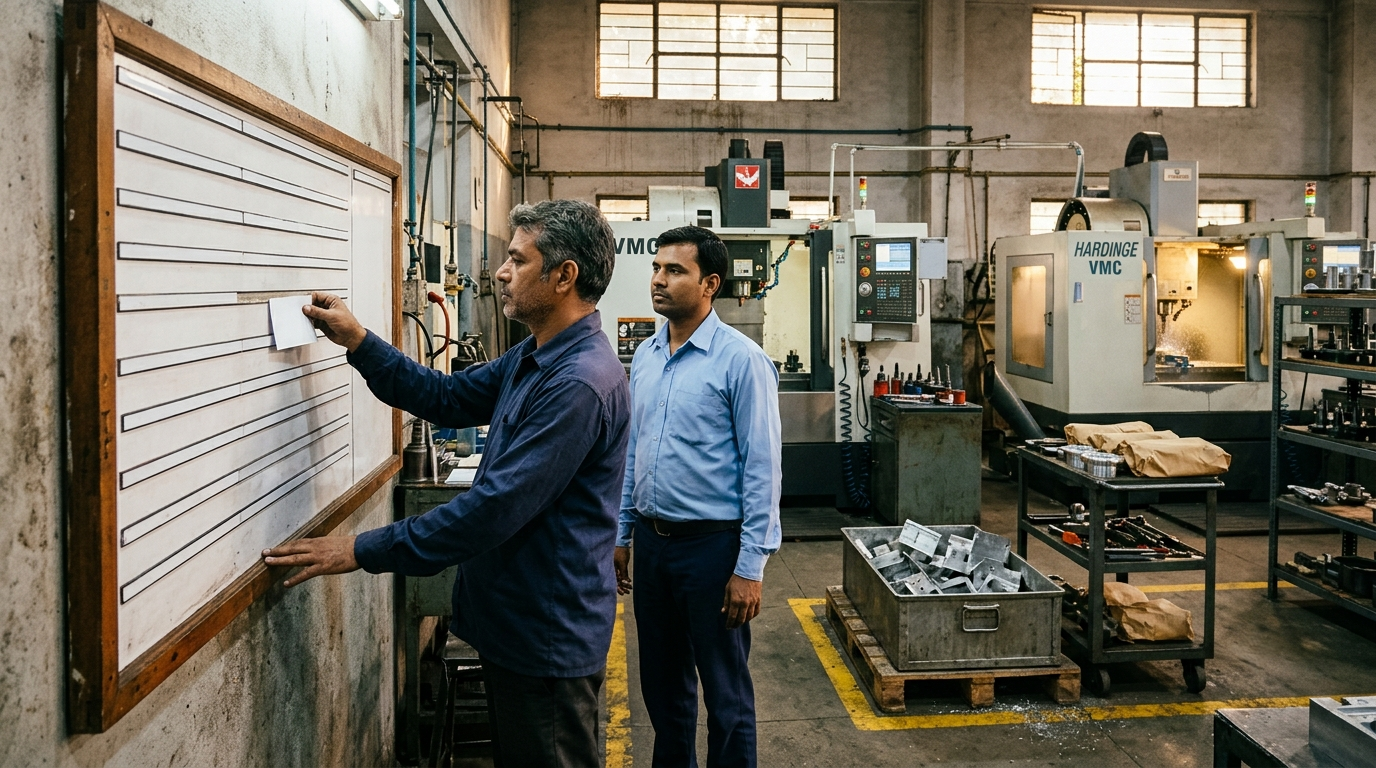
One machine or process usually sets the pace for the whole shop. Write the hours of work waiting at it on a board, updated daily. Every date you give starts from that number.
2 Release a job only when it is ready
Before a job is given to the floor, check: material in, drawing at the current revision, programme proved, tools and fixtures ready. If one is missing, the job waits in the office, not at the machine. A short written checklist works. It saves the half-started jobs that eat dates.
3 Count outside work and inspection into every date
These are the parts of the lead time that nobody on the floor controls, and where dates are most often lost. Give each one a day count, and ask the outside vendor for a date, not "two days."
4 Put the promised date on the job and on the plan
The date should be written on the job card and shown on a daily plan everyone reads. See a daily production plan format to start. When the date is on the plan, a hot job that threatens it becomes visible to everyone.
5 Name one owner for each date
Not "the shop." One person who looks at that date every morning, sees if it is slipping, and speaks to the customer first. If that person is always you, see why the floor can't run without you.
6 Tell the customer before they ask
When a date will slip, tell the customer as soon as you know, with a new date you have checked. Customers judge a supplier more by how it handles a late job than by whether the job was ever late. And measure it: promised date against shipped date, for every job, every month.
Common Worries
- "If I give longer dates, I'll lose the order." Some, perhaps. But a date you miss costs you the next order and your rating with the OEM. Customers keep suppliers who are reliable more than suppliers who are quick.
- "Dates change anyway, so why plan?" They change because they were set without checking. A date built from the queue and the buffer moves far less often.
- "My sales person needs a date on the call." Give them a simple rule: a standard lead time for standard jobs, and "I'll confirm by 5 PM" for everything else.
- "A buffer is padding." A buffer is a plan for the things that will happen: a breakdown, a rework, a hot job. A shop with none is planning for a week that never comes.
Example: Same Shop, Same Machines, Different Dates
Take an example shop (hypothetical): 35 people, 12 CNC machines, 30 live jobs. On-time delivery is around 70 per cent. The owner is considering a new VMC.
- Week 1: for ten late jobs, the team notes the cause. Four were released without material, three were delayed by outside work, two were pushed by hot jobs, one was a breakdown.
- Week 2: a ready-check is added before release, and the date for every new job is built from the queue on the bottleneck. A "confirm by 5 PM" rule goes to the sales person.
- Weeks 3 and 4: each promised date goes on the daily plan with one named owner. Slipping jobs are raised in the morning meeting, two days before due.
Nothing was bought. The shop stopped guessing dates and started checking them.
Signs Your Delivery Is Getting More Reliable
- No date is given on a call without a check, or a "confirm by" time
- Jobs reach the machine with everything in hand
- Every promised date has one named owner
- Late jobs are raised two or three days before the due date, not on it
- Customers call you less to ask where their order is
Where to Start This Week
- List the last ten late jobs and write the main cause of each.
- Write the hours waiting at your bottleneck on a board.
- Use the five-question check before every date you give.
- Name an owner for every promised date, and look at them each morning.
None of this needs new software or new machines. It needs the date to be set from facts, and watched. If you do want a tool to hold those dates, see Excel vs ERP vs a workflow system for what each can and can't do on the floor.
How We Solve This
At KeshRaghTech we start with an Operational Workflow Review: we trace where your promised dates are lost, from the first call to dispatch, including release rules, outside work, priority changes and who owns each date. Then we design the rules with your team and deliver them as a workflow application built around how you run, so the queue, each job's readiness and each promised date are visible to everyone, and slipping jobs show up days before they are due. We coach your team until the shop gives dates it can keep.