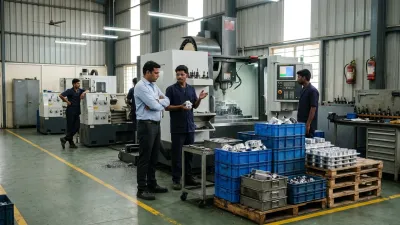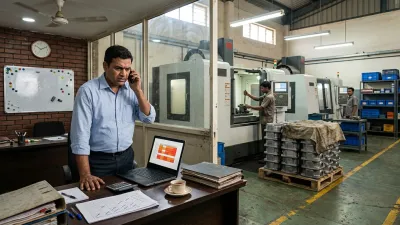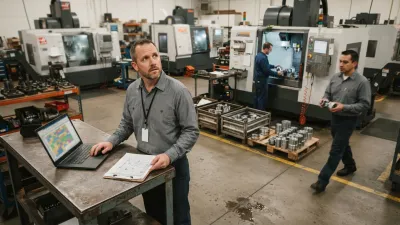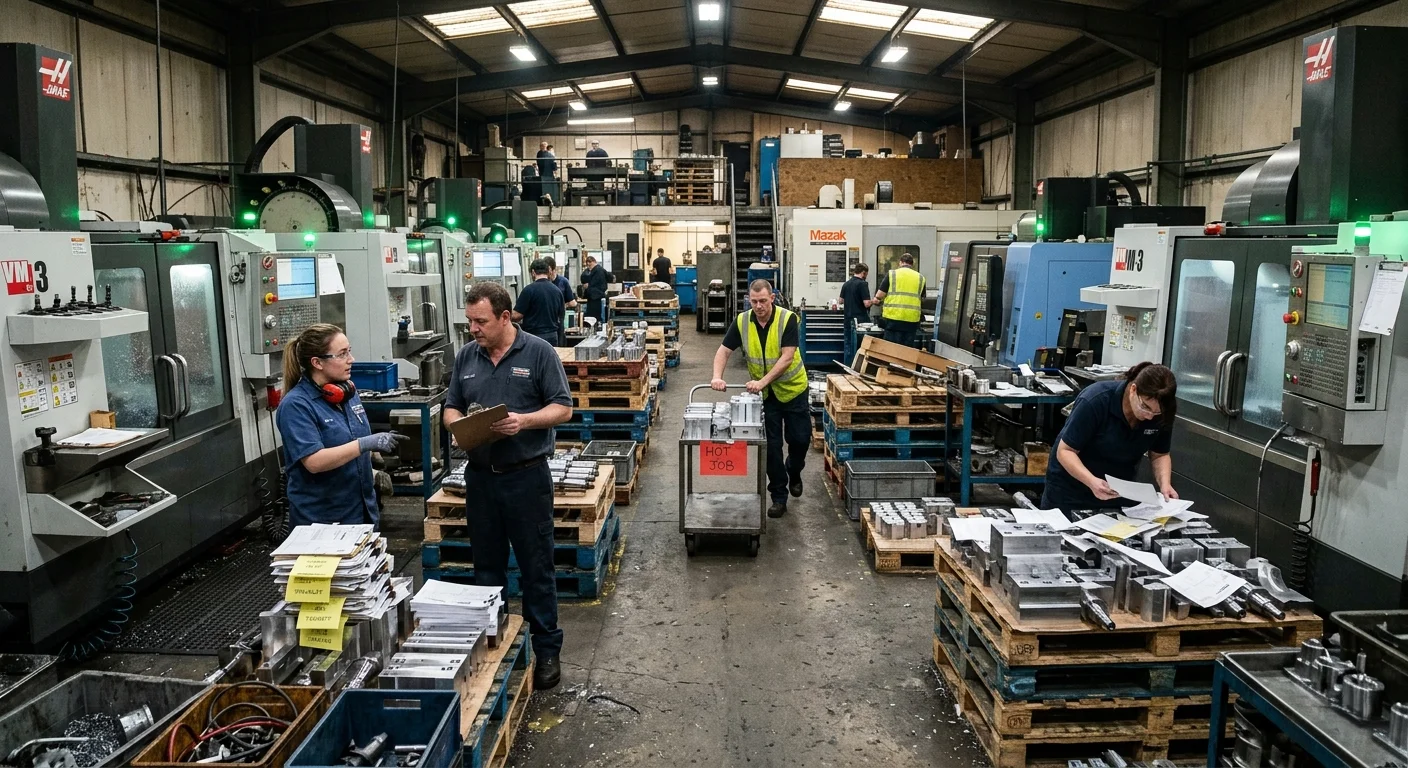
Walk through almost any busy CNC job shop and the first impression looks positive. Machines are running. Operators are moving. Parts are everywhere. People are busy.
Spend a full day there and a different picture appears: jobs waiting between operations, operators asking what to run next, priorities changing mid-shift, expedites disrupting planned work, and parts sitting untouched for hours or days. Despite everyone working hard, output still feels unpredictable.
That's because production flow rarely breaks from one big failure. It breaks from dozens of small, everyday decisions that slowly push the shop out of control. This article explains what production flow really means, the four decisions that break it in CNC job shops, and five steps to restore it.
What Is Production Flow?
Production flow is not keeping machines busy, maximizing spindle time, releasing more work or moving faster everywhere. Real flow means:
The right jobs move through the right sequence at the right time, without creating congestion downstream.
You can see good flow in two places: how long a job takes from release to dispatch, and how much of that time it's actually being worked on rather than waiting. In most job shops, jobs spend far more time waiting in queues than being machined.
Take a job that needs about six hours of machining across four operations: turning, milling, deburring and inspection. If it takes ten working days from release to dispatch, it spent less than one of those days being worked on. The rest was waiting: for a machine, for a setup, for material, for a decision. That waiting time is what flow is really about, and it's where most of your lead time hides.
The Common Assumption
Most shops believe flow breaks because of machine downtime, operator shortages, capacity limits or too much incoming work. Those things matter. But in many job shops, flow breaks long before capacity runs out, because the shop loses control of how work moves. Once that happens, every decision becomes reactive, priorities become unstable, scheduling becomes unreliable and work piles up unevenly. The shop stays active, but flow disappears.
What Breaks Production Flow: 4 Everyday Decisions
1. Work is released too early
A job enters the floor before its tools are ready, its fixtures are free, the previous operation is stable or there's realistic capacity for it. Why? Because nobody wants machines waiting, so work gets pushed out "to keep things moving." Instead, it floods the floor. Queues grow, jobs compete for the same machines and people, and operators start choosing work by convenience instead of priority. This is exactly why WIP keeps increasing in CNC shops: not because people are slow, but because too much work entered without control.
2. Priorities keep changing
A schedule gets made, then reality hits: an urgent customer call, delayed material, a machine issue, an inspection hold, a setup that runs long. Someone pushes another job ahead. Then another. Soon nobody trusts the schedule, operators stop following it and dispatch becomes verbal and reactive. The schedule no longer controls production. The chaos controls the schedule. That's why CNC schedules fail every day.
3. The wrong numbers drive decisions
Machines running all day looks productive, and high utilization looks efficient. But when utilization becomes the goal, work gets released early, batches get bigger, machines run jobs that aren't priorities and queues grow between operations. The shop looks busy while flow gets worse. That's why machine utilization numbers are lying to you: a busy machine doesn't mean a flowing shop.
4. Nobody owns flow
Planning owns the schedule. Operators own their machines. Supervisors own manpower. Quality owns inspection. But nobody owns how work moves across the whole shop. So every department optimizes for itself, while lead times grow, visibility drops and jobs stall between operations. It's also why many ERP implementations fail to create real operational stability: the workflow underneath stays uncontrolled.
Signs Production Flow Is Broken on Your Floor
- Pallets and trolleys of parts waiting between machines
- "Hot jobs" constantly interrupting planned work (here's what to do when every job is urgent)
- Operators searching for tools, fixtures or drawings
- Many jobs started, few finished
- Material moved around the floor more than it's machined
- Nobody can say with confidence what will actually finish today
That last one is the clearest sign. Uncertainty about today's output is what broken flow feels like. Getting it back starts with knowing where every job is, and what it's waiting for.
What Broken Flow Costs You
Broken flow hits delivery reliability, throughput, lead times, margin and customer confidence. It also wears people out. Supervisors spend all day firefighting, operators lose trust in priorities, planning turns into constant rescheduling and leadership runs the business in reaction mode. Most people in the shop feel it long before the management figures show it.
How to Improve Production Flow: 5 Steps
Flow improves when the shop becomes controlled, not just busy. These five steps get you there.
1. Control what enters the floor
Release a job only when its material, program, tooling and drawing are ready, and release new work at roughly the pace your slowest operation can finish it. Jobs that aren't released stay as paperwork, not as half-finished parts blocking the floor.
2. Limit the work waiting at the bottleneck
Decide how much work may wait in front of your slowest operation; about one shift's worth is a good start. When that queue is full, upstream machines don't start new work for it.
3. Agree one priority list a day
Hold a short daily priority review, starting with the sequence at the bottleneck. Everyone works from the same list until the next review, so urgent jobs stop arriving from three directions.
4. Give one person ownership of flow
Name one person, usually the production manager, who owns how work moves across all operations, not just one machine or department. Their daily job is to walk the queues and clear what's stuck.
5. Track lead time and the oldest job, not activity
Measure how many days jobs take from release to dispatch, and how long the oldest open job has been on the floor. Those two figures show whether flow is improving far better than any utilization report.
Improving flow doesn't mean doing less business. It means less overload: fewer half-finished jobs, fewer shifting priorities and fewer jobs fighting for the same machines. The result is more reliable throughput, shorter lead times and more usable capacity, because a shop that finishes work steadily outperforms one that starts everything early.
Where to Start This Week
Walk the floor and list every job that's been started but isn't being worked on right now, with how long it's been waiting and what it's waiting for. That one list shows you where flow breaks in your shop. If most jobs are waiting for the same machine, that's your bottleneck: start limiting the work released in front of it. To confirm it before you act, use the checks in how to identify bottlenecks in manufacturing. If they're waiting for material, programs or tools, start the readiness check before release. If they're waiting for a decision, start the daily priority review.
Busy Is Not the Same as Controlled
If your shop constantly feels overloaded, reactive, unpredictable and dependent on expediting, the issue is usually not effort, and often not capacity either. Production flow has slowly broken down across the shop. Most shops don't notice straight away, because everyone is still busy. But busy and controlled are not the same thing.
How We Solve This
At KeshRaghTech we start with an Operational Workflow Review to trace how jobs actually move through your shop and where they wait. Then we design release rules, WIP limits and priority rules that fit how you run. We deliver them as a workflow application built around your shop, so everyone sees what's released, what's next and where each job is, and we coach your team until it runs that way every day.
Related reading: Why Your WIP Keeps Increasing (and How to Reduce It) · Why CNC Schedules Fail Every Day · Why Machine Utilization Numbers Are Lying to You · How to Identify Bottlenecks in Manufacturing · When Every Job Is Urgent · Where Is My Job?