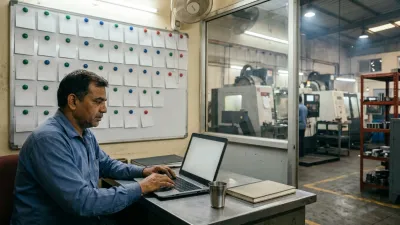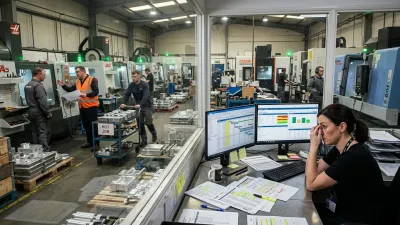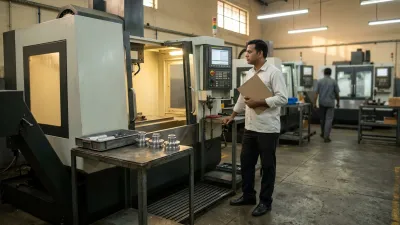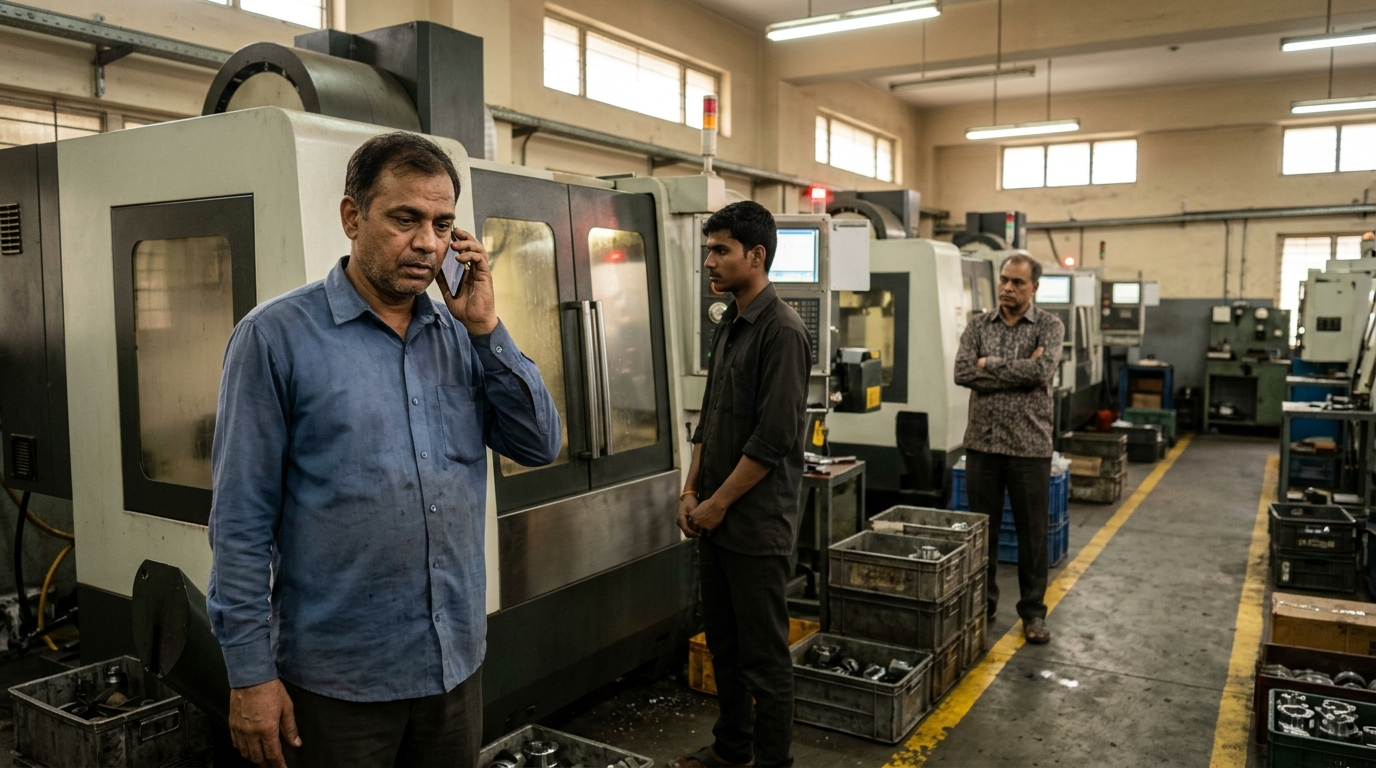
You take two days off, and the phone rings forty times. Which job goes next on VMC 3? Can the supplier's material be accepted with this mark? The customer wants a date. The supervisor is "waiting for your word" on overtime. You answer from a bus or a wedding hall, and the shop keeps moving, but only because you answered.
Many owners of CNC job shops tell us the same thing: "Only I know how this shop runs." It sounds like pride, and it is also a warning. A shop that stops when the owner steps away is carrying a risk that has nothing to do with machines.
This article explains why the floor ends up depending on one person, what it costs, and six steps to move decisions out of your head and into rules your team can follow, without losing control.
What an Owner-Dependent Shop Looks Like
You can usually spot it in a normal week:
- Operators wait. A job finishes and the operator walks to the office to ask what is next, or stands by the machine until someone decides.
- The supervisor won't decide. Overtime, rework, an outside process, a changed sequence: each one needs a call to you.
- You know things nobody else does. Which customer can wait, which cannot, which job needs a special fixture, which supplier is late again.
- Your day starts with questions. Before you look at the plan, you are answering the floor.
- Leave is a problem. Output dips, deliveries slip, and a week away costs two weeks of catch-up.
What It Really Costs
The cost is not only your time. Here is a typical week for a 30 to 50 person shop (the numbers are hypothetical, but most owners will recognise them):
| Where the time goes | Per day |
|---|---|
| Answering floor questions that follow a pattern (next job, overtime, rework) | 1 to 2 hours |
| Walking the floor to check things nobody else will confirm | 1 hour |
| Phone calls to and from the supervisor on leave days | 1 to 2 hours |
That is three to five hours of the owner's day, every day. Beyond the hours:
- The shop can't grow. Every new machine and shift adds more questions, and you are the limit.
- Machines and people wait. A ten-minute wait for an answer, repeated through the day, becomes lost spindle time.
- People stop thinking. If every decision is yours, supervisors learn to ask, not to decide.
- Everything is urgent. When only you know what matters, anything you mention becomes a rush job, which feeds the cycle where every job is urgent.
- The risk is yours alone. Illness, a family event or a long trip can stop the shop. The owner's time is one of several hidden costs, see what a shop loses without a workflow system for the others.
Why the Floor Ends Up Depending on One Person
1 The shop grew around your judgement
In the early years you made every decision, and it worked because there was less to decide. As the shop grew, the number of decisions grew with it, but the rules stayed in your head.
2 Priorities are never written down
Which customer comes first, which delay is acceptable, what counts as urgent: these are in your head, so every change in plan needs you. If you want the plan itself to hold, start with a daily production plan format the floor can follow.
3 Supervisors have no clear limits
Without a stated limit, the safe move for a supervisor is to ask. Asking costs five minutes. A wrong decision might cost them your trust. So they ask.
4 Know-how is spoken, not written
The fixture trick, the inspection point, the program that needs a manual offset: one or two people know. When they are away, the job slows or goes wrong.
5 Nobody can see the whole picture
If job status lives in people's heads, only the person with the widest view can decide. That is usually you. See why you have to walk the floor to find a job.
6 Every exception comes back to you
Plans break every day, as in why the CNC schedule fails every single day. With no rule for what to do when it breaks, each break becomes a question for the owner.
How Many of Your Decisions Are Really Yours?
Try this for one week. Each time a question reaches you from the floor, note it in one line. Then group them:
| Type of decision | Example | Who should decide |
|---|---|---|
| Routine, follows a pattern | Next job in the queue, small overtime, standard rework | Supervisor, using a written rule |
| Needs a limit | Overtime beyond two hours, an outside job, a rejected lot | Supervisor up to a limit, you above it |
| Changes a commitment | New delivery date, a price or quality concession | You, with the facts ready |
| Real exception | Machine breakdown, a safety issue, a major customer complaint | You, or whoever is named in your absence |
Most owners find that six or seven out of every ten questions fall in the first two rows. Those are the ones to move out of your head.
Six Steps to a Shop That Runs Without You
1 Write down the five decisions you make most often
Use your week of notes. Pick the five that come up most. For each, write what you decide and why, in two or three lines. That is the start of your shop's rule book.
2 Set a limit for each decision
For example: "Overtime up to two hours: supervisor decides. Above two hours: call me." "Rework up to 5 pieces: supervisor. More: call me." A limit lets people act, and tells them when to call.
3 Hold a ten-minute start-of-shift meeting on one plan
Review today's jobs, what is at risk and what is stuck, and agree who does what. When the plan is shared and agreed, people don't need to ask you what to do. See a daily production plan format for how to set it up.
4 Name who decides when you are not there
One person per shift, by name, with their limits written on the wall. Everyone knows who to ask, and it isn't you.
5 Write down the know-how that sits in one head
For each tricky job: the fixture, the inspection point, the offset, the thing that goes wrong. A single page with a photo is enough. Start with jobs that only one person can run.
6 Review exceptions, not every decision
At the end of the week, look at the calls that still reached you. Each is either a new rule to write or a limit to adjust. Over a month, the number of calls falls, and the ones that remain are the ones that need you.
Common Worries
- "They will make mistakes." Yes, some. A wrong decision inside a limit costs little. A shop that waits for you costs more every day.
- "I'll lose control." You lose control of small decisions and gain it over the big ones. The weekly review of exceptions keeps you informed.
- "My people aren't ready." People rarely decide well without rules. With a clear rule and a limit, most do.
- "I don't have time to write all this." Start with five decisions, one page each. It takes an evening, and it saves hours every week.
Example: From Forty Calls to Six
Take an example shop (hypothetical): 40 people, two shifts, an owner who is away for a family function for three days. Before, the owner took around forty calls a day on leave days.
- Week 1: the owner notes every floor question for five days and finds that most are about next job, overtime and rework.
- Week 2: five rules are written with limits. A named person decides for each shift. A ten-minute meeting starts each morning.
- Weeks 3 and 4: the weekly review turns two more repeated calls into rules. The next time the owner is away, calls fall to a handful, and most are real exceptions.
The shop did not change its people or its machines. It wrote down how decisions are made.
Signs the Shop Is Less Dependent on You
- Operators know what to run next without asking the owner
- Supervisors decide inside written limits, and call only above them
- A named person decides on each shift in your absence
- Know-how for tricky jobs is written down and shared
- You can be away for a day without a floor call about routine matters
Where to Start This Week
- For five days, note every floor question that reaches you.
- Pick the five most frequent and write what you decide for each.
- Give each a limit, and tell your supervisors in a short meeting.
- Start a ten-minute start-of-shift review of the day's plan.
None of this needs new software. It needs the shop's decisions to be written down, and the people who make them to know their limits.
How We Solve This
At KeshRaghTech we start with an Operational Workflow Review: we trace which decisions reach you and why, where the plan and job status are unclear, and which know-how sits in one head. Then we design simple decision rules, limits and handoffs with your team, and deliver them as a workflow application built around how you run, so priorities, status and approvals are visible to everyone, supervisors can decide inside their limits, and you see only the exceptions. We coach your team until the shop runs the same way whether you are there or not.