Ask a CNC job shop owner how much work-in-progress is on the floor, and the usual answer is "a lot". Ask how much exactly, in jobs, in cash, or in days of lead time, and it gets quiet. The accountant has a WIP figure once a month. The floor has crates everywhere. Nobody connects the two.
Knowing how to calculate WIP properly answers three questions every owner cares about: how much cash is sitting on the floor, why jobs take as long as they do, and how much could be freed by running with less. This guide covers the accounting formula, how to count and value WIP on the shop floor, how WIP turns into lead time, how to tell whether you have too much, and a free WIP calculator that does the maths in a minute.
Two Meanings of WIP
WIP, work-in-progress or work-in-process, means jobs that have been started but not finished. It's measured two ways, for two different purposes:
| Accounting WIP | Shop-floor WIP | |
|---|---|---|
| What it measures | Value of unfinished production | Jobs released to the floor and not yet shipped |
| Unit | Money | Jobs (and their value) |
| How often | Month end or year end | Any day you want |
| Used for | Balance sheet, cost of goods sold | Lead time, cash on the floor, release decisions |
Both matter. But only the second one helps you run the shop, and most shops never calculate it.
The Accounting Formula for WIP
The standard formula your accountant uses is:
Ending WIP = Beginning WIP + Manufacturing costs − Cost of goods manufactured
- Beginning WIP: the value of unfinished work at the start of the period (last period's ending WIP).
- Manufacturing costs: direct material issued, direct labour and the overhead applied during the period.
- Cost of goods manufactured: the cost of jobs completed and moved to finished goods in the period.
Example (hypothetical): the month starts with ₹8 lakh of WIP. During the month, ₹40 lakh of material, labour and overhead go into production, and ₹37 lakh worth of jobs are completed. Ending WIP is 8 + 40 − 37 = ₹11 lakh.
That number is correct and necessary for the accounts. But it arrives once a month, it doesn't say which jobs make it up or where they are, and it doesn't tell you why WIP went up by ₹3 lakh. For that, you need to count it on the floor.
How to Count WIP on the Shop Floor
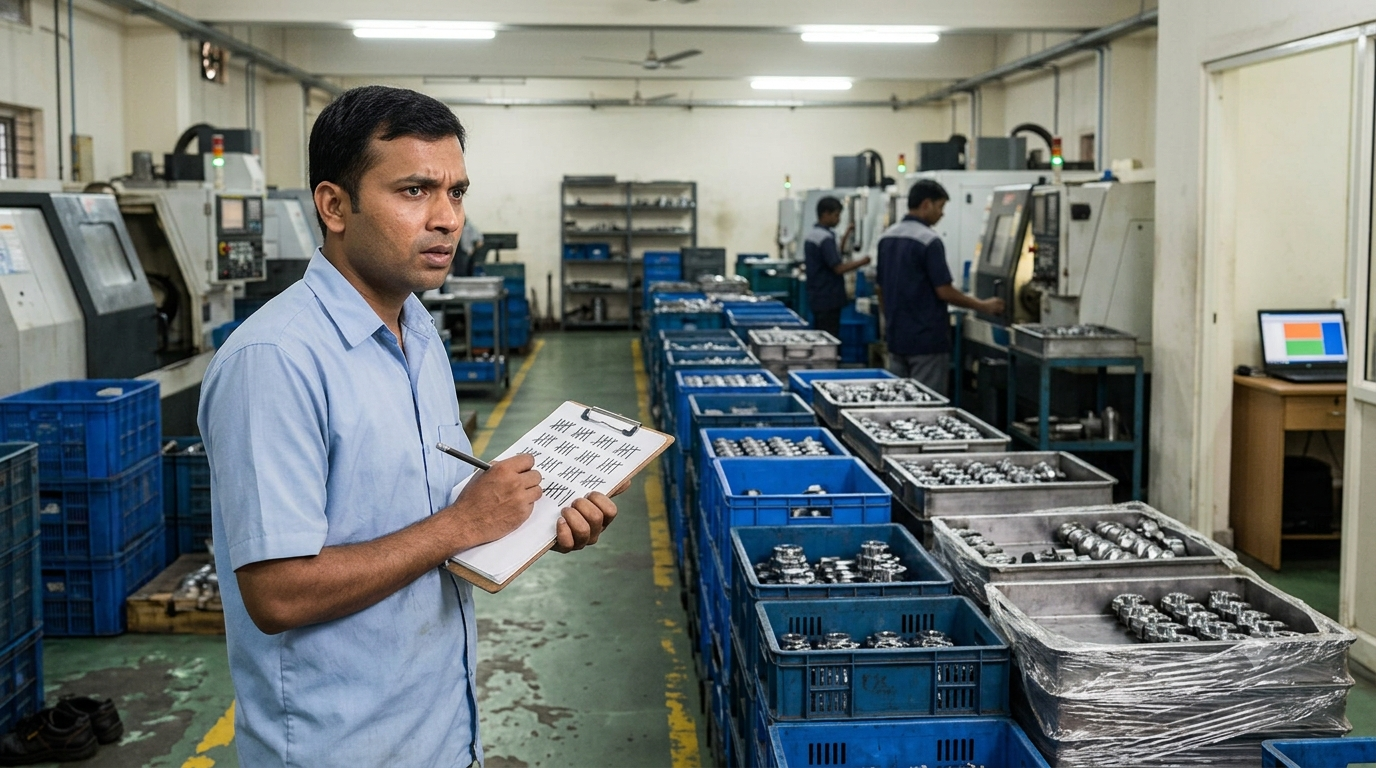
A floor count takes an hour or two the first time, and much less once jobs carry tags and queues have marked places. Count every job that has been released to the floor and not yet shipped:
- Running: jobs on a machine right now.
- Waiting: jobs in a queue for the next machine, inspection or deburr.
- On hold: jobs stopped for material, a program, tooling, a drawing query or a quality issue.
- Out: jobs at an outside supplier for heat treatment, plating, grinding and the like. They're still your WIP.
- Finished, not shipped: jobs waiting for final inspection, packing or dispatch.
Record the count by location as well as the total. An example count:
| Where | Jobs |
|---|---|
| Running on machines | 9 |
| Waiting in front of machines | 27 |
| Waiting for inspection | 8 |
| On hold | 7 |
| Out at suppliers | 6 |
| Finished, waiting for dispatch | 3 |
| Total WIP | 60 jobs |
The split is often more useful than the total. In this example, only 9 of 60 jobs are actually being worked on. The other 51 are waiting for something. If you can't tell where a job is without looking for it, that's a problem of its own, covered in "Where Is My Job?".
How to Value WIP
To turn the count into money, you need the average value of a job on the floor: the material already issued plus the work already done on it.
- Accurate method: for each job, add material cost and the hours already worked × your hourly machine-and-labour rate. Sum across all open jobs.
- Quick estimate: material is usually all issued at release, and on average a job on the floor is about half-way through its work. So material cost plus half the job's processing cost is a reasonable value. If you don't have those figures, half to two-thirds of the average order value is a rough starting point.
Then: cash on the floor = number of open jobs × average value per job. With 60 jobs at ₹30,000 each, that's ₹18 lakh of cash spent and not yet billed.
From WIP to Lead Time: Little's Law
This is the most useful calculation in the article, and the one most shops have never done. Little's Law, a basic rule that holds for any production system, says that on average:
Average lead time = WIP ÷ throughput
Throughput is the number of jobs you finish and ship per week (or per day). With 60 jobs on the floor and 15 shipped a week, an average job spends 60 ÷ 15 = 4 weeks in the shop. At 6 working days a week, that's 24 working days from release to dispatch.
Two things follow, and both surprise people:
- With the same output, more WIP means longer lead times. Release 30 extra jobs to the floor without adding capacity, and the average job takes 6 weeks instead of 4. Nothing gets made faster. Everything just waits longer.
- Less WIP means shorter lead times, without working faster. Bring WIP down to 40 jobs at the same output, and average lead time drops to about 16 working days.
This is why releasing every order to the floor as soon as it arrives backfires, and why WIP keeps increasing in shops that do it.
How Much WIP Is Too Much?
There's no universal number, but three comparisons tell you a lot:
1 Lead time against work content
Take a typical job and add up the actual hours it spends being worked on: setups, machining, inspection. Compare that with the average lead time from Little's Law. If a job needs 10 hours of work and spends 24 working days in the shop, it's being worked on for a small fraction of the time. The rest is waiting, and that waiting is WIP you could remove.
2 Lead time against what you quote
If your average lead time from Little's Law is longer than the lead time you promise customers, many jobs will be late before they start, and they'll turn urgent near their due dates. That's how a shop ends up in the cycle where every job is urgent.
3 The trend
Count WIP at the same point every week or month. If WIP rises while output stays flat, lead times are getting longer, even if nobody has noticed yet.
What WIP Really Costs
The cash on the floor is only the start:
- Cost of money: ₹18 lakh at 12% a year is about ₹2.2 lakh a year in interest, or the cost of not having that cash for something else.
- Floor space and handling: crates moved twice, aisles blocked, time spent looking for jobs.
- Damage and rework: parts that wait longer get knocked, rust or get mixed up.
- Changes and cancellations: the longer a job sits, the more likely the customer changes it, leaving half-made parts nobody needs.
- Expediting: long queues mean jobs approach their due dates while waiting, and get rushed through, interrupting everything else.
Most of these never appear on a report, which is why WIP feels cheaper than it is.
Worked Example: What Cutting WIP Frees Up
Take the example shop above (the numbers are hypothetical): 60 open jobs, ₹30,000 average value, 15 jobs shipped a week, 6 working days, money costing 12% a year.
| Today | With 30% less WIP | |
|---|---|---|
| Open jobs | 60 | 42 |
| Average lead time | 24 working days | About 17 working days |
| Cash on the floor | ₹18 lakh | ₹12.6 lakh |
| Cash freed | - | ₹5.4 lakh |
| Cost of money | About ₹2.2 lakh a year | About ₹1.5 lakh a year |
The output is the same 15 jobs a week, because the 18 jobs removed weren't being worked on anyway: they were waiting. The shop gets more than a week of lead time back and ₹5.4 lakh of cash, without a new machine or extra shift.
Free WIP Calculator
We built a free calculator that does all of this for your own numbers. Enter your open jobs, the average value of a job on the floor and your weekly output. It shows your average lead time, the cash on your floor and its yearly cost, compares the lead time with what you quote, and shows what a WIP reduction would free up. It works in rupees, dollars, pounds or euros, and nothing you type is sent or saved.
Once You've Measured It: How WIP Comes Down
Measuring WIP doesn't reduce it. These do:
- Release work at the pace the shop finishes it. New jobs go to the floor when the bottleneck can take them, not when the order arrives. If you're not sure which machine that is, here's how to identify bottlenecks in manufacturing. The free Bottleneck Finder does the sums for you.
- Release only ready jobs. A job without material, program or tooling just becomes another job on hold.
- Finish before starting. Each machine completes the jobs it has started before taking new ones.
- Clear the on-hold list. Every held job gets an owner and a date, and is reviewed daily.
Count again after a month. If WIP is down and output is steady, lead times will already be shorter.
How We Solve This
At KeshRaghTech we start with an Operational Workflow Review: we count where WIP actually sits in your shop, trace why jobs wait, and find how work is released to the floor. Then we design release, readiness and priority rules around your bottleneck, and deliver them as a workflow application built around how you run, so WIP, lead time and every job's status are visible every day, not once a month. We coach your team until running with less WIP is routine.