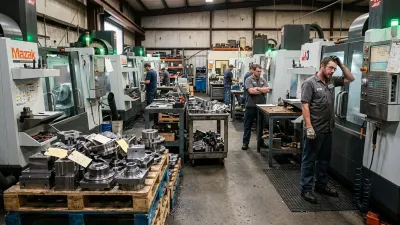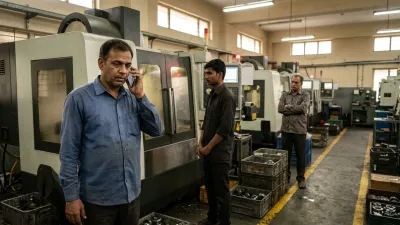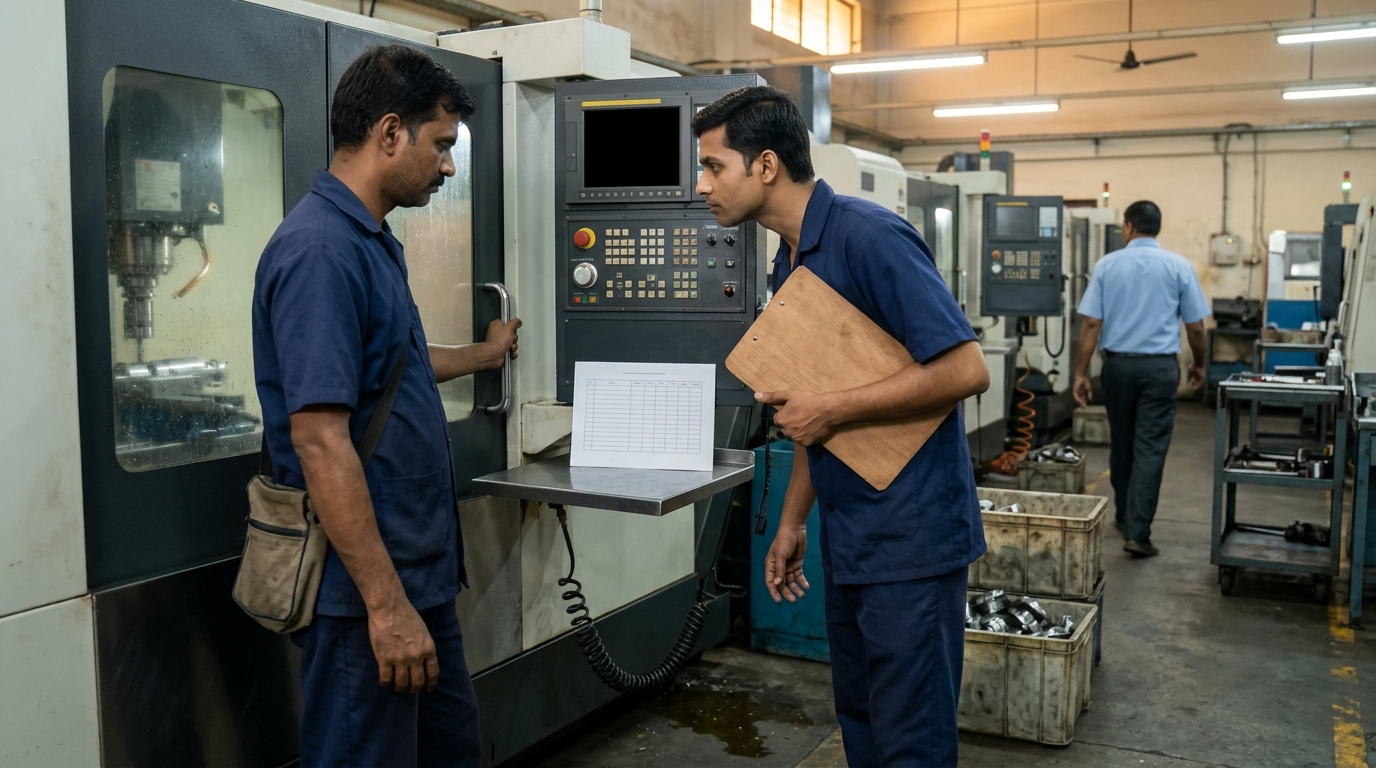
The second shift walks in at 2 PM. The operator on VMC 4 is already putting his bag on his shoulder. "Which job is this? Is the offset changed? Did the first piece pass?" Three questions in two minutes, answered while he is leaving. Half of it is forgotten by evening.
Most CNC job shop owners we speak to have seen this: the night shift repeats a setup the day shift did, a rejected job is found in the morning, and the owner's phone rings at 8 AM with "what happened last night?" The machines are running. The information is not.
This article explains where shift handover goes wrong in a CNC shop, what to put on a handover sheet (including the program, offset and tool details that generic checklists leave out), and how to run it in five minutes without adding a person or buying software. There is a free one-page sheet to print at the end of the first section.
What a Shift Handover Is (and Isn't)
A shift handover is a short, structured transfer of what is open: what the next shift must know to carry on without asking. It looks forward.
| Shift handover | Shift or daily production report | Daily production plan | |
|---|---|---|---|
| Looks at | What is open and what to watch next | What was made, rejected and lost | What each machine should run today |
| Written | During the last hour, read at shift change | After the shift | Before the shift |
| Read by | The incoming supervisor and operators | The owner or manager, for numbers | The whole floor |
A shop can have a good report and still have a bad handover: the numbers are correct and the next shift still starts blind. The report says what happened. The handover says what happens next.
What Is Lost at a Shift Change
Handover fails less from carelessness than from timing. The outgoing operator has the most knowledge at the moment he has the least time. What usually gets lost:
- Where the job stopped. "Running" tells the next shift nothing: how many pieces are done, and what is left?
- What was changed. A tool offset, a modified program, a different insert. The drawing and job card still show the old state.
- What went wrong. A rejected lot, a measurement near the limit, a fixture that moves. Known to one person, found again by the next.
- What is blocked. Material not in, tool out for regrinding, waiting for inspection. The next shift loads the job and stops again.
- What changed in priority. The customer called at 5 PM. The supervisor knows. The night shift runs the old order.
What It Costs
An example for a two-shift shop with 12 machines (hypothetical, but most owners will recognise it):
| Where the time goes | Per shift change |
|---|---|
| Questions and a walk round to find out the state of each machine | 15 to 30 minutes |
| A repeated setup, offset or first-piece check on one or two machines | 30 to 60 minutes |
| A problem found late, on a job that has already run | 1 job in a week |
Against 12 machines running at that hour, half an hour of lost start-up each day is several spindle hours a week. The bigger cost is the job that runs wrong for a whole shift because the warning stayed with the person who went home. It also feeds "where is my job?" the next morning, because nobody can say with certainty where the work stands.
Why Handover Goes Wrong
1 It is only spoken
Words said in a hurry, over machine noise, with one person leaving, are not a record. They depend on what the outgoing operator thinks to say and what the incoming one thinks to ask.
2 There is no time for it
Shifts are timed to the minute: one ends at 2:00 and the next begins at 2:00. There is no overlap, so handover happens in the gap, or not at all.
3 Nobody owns it
If handover is "everybody's job", it is nobody's. When something is lost, there is no one to ask and no sheet to look at.
4 It has no fixed format
Each operator says what he remembers. One mentions the offset and forgets the material. Another does the reverse. The next shift cannot tell what was left out.
5 Priorities change after the plan is made
The day shift worked to the morning's plan. A hot job arrived in the afternoon, as in what happens when every job is urgent. If the change does not travel with the handover, the night shift runs the wrong job first.
The Handover Sheet: What to Put on It
One page, one line per machine, filled in by the operator during the last hour of the shift, not at the end. Generic handover checklists are written for process plants and cover permits, lockout and line status. A CNC shop needs the lines below.
| Item | What to write | Why it matters |
|---|---|---|
| Job, operation, revision | Job number, operation number, drawing revision | Stops the wrong job or revision being continued |
| Quantity | Done / left / rejected | Gives the true state, not "running" |
| Program and where it stopped | Program name or number, and the block or point it stopped at ("between cycles" if idle); whether the control is in auto, single block or MDI | The next operator restarts from a known point, not a guess |
| Offsets, tools and tool life | Offsets changed and by how much, tool or insert changed, pieces left on the current insert | Saves a repeat setup, and stops a worn tool failing at 3 AM |
| Fixture and workholding | Fixture number, how the part is clamped, anything non-standard | The same job clamped differently gives a different result |
| Quality | Last measured value on the critical dimension, time measured, any near-limit or rejected pieces | Warns the next shift before it makes more |
| Temporary measures | Any workaround in force, who approved it, and what must happen before it is removed | The riskiest item: it is invisible once the person leaves |
| Blocked or waiting | What is missing (material, tool, drawing, outside work) and who is chasing it | Stops a job being loaded that cannot run |
| Next job | Job number, and ready or not ready (material, programme, tools, fixture) | The next shift starts it without asking |
| Machine condition | Alarms, noise, vibration, coolant level, anything abnormal | Catches a breakdown before it happens |
Add a short block at the top for the whole shop, filled by the supervisor: priority changes since the plan was made, machines down, material or outside work expected, staff absent or covering a machine they don't normally run, and customer calls that matter. Add the supervisor's name and the time, and finish with one thing to watch this shift, in a single sentence. If everything else is skimmed, that line is read.
If you already use a daily production plan, the handover sheet is its other half: the plan says what should happen, the handover says what did and what is still open.
A one-page version to print
We have put all of this on one A4 page: a whole-shop block, eight machine lines, a space for the one thing to watch, and a sign-off. Print it, laminate one for each shift, or copy it into your own format.
- Download the Shift Handover Sheet (PDF): free, no sign-up.
What a Good Entry Looks Like
Most handover failures are not a missing sheet but a weak entry. Compare two lines for the same machine:
| Weak entry | Strong entry | |
|---|---|---|
| Job and quantity | VMC 4: running | VMC 4: job 2217, op 20, rev C. Done 140, left 60, rejected 2 |
| Changes | Offset changed | X offset on T4 moved +0.03 after piece 90; program not edited |
| Quality | OK | Bore 25.012 at 1:40 PM, limit 25.015. Check every 10 pieces |
| Waiting | Material issue | Next lot of bar not in. Purchase chasing, promised 6 PM |
The weak entry takes five seconds to write and five minutes to find out the truth. The strong entry takes a minute to write and saves the question altogether.
Temporary Measures: The Item That Hurts Most
A temporary measure is anything done to keep a job running that is not in the drawing, the program or the job card. It is the most dangerous line on the sheet, because the person who knows it is about to go home. Examples in a CNC shop:
- An offset adjusted by hand to hold a size, with the program left as it was
- One more job on a tool that is near the end of its life
- An inspection step skipped or changed with the customer's agreement
- A different material lot, or a part clamped in a non-standard way
For each one, write three things: what it is, who approved it, and what must happen before it is removed (a new insert, a corrected program, a confirmed deviation). A workaround with no end condition becomes the standard method without anyone deciding it.
If a Machine Is Mid-Cycle at Shift Change
Where possible, let the cycle finish, or stop at a planned point such as the end of a part or after a tool change. If a machine must change hands mid-program, the outgoing operator writes the program and block where it stopped and what has been done to the part, and tells the incoming operator face to face. The incoming operator checks the offsets and the part against the sheet before restarting, and runs the first move with care (single block, reduced feed, hand on the stop). Follow your machine builder's manual for restart procedures: these are general good practice, not a replacement for it.
Five Steps to Run It
1 Fix a handover time and make it paid
Ten minutes of overlap at the machines, with both operators on the floor together. It is cheaper than the first hour lost every day to questions. If there is truly no overlap, create one: move the outgoing supervisor's end time, or the incoming supervisor's start time, by ten minutes. Until then, use the sheet plus a photo of each machine screen and job card, and keep the outgoing supervisor reachable for the first 30 minutes.
2 Write during the shift, not at the end
Operators note the machine line when a job starts, changes or stops. At handover, it only needs a check, not a memory test. Show new operators one strong entry and one weak entry in their first week.
3 Say it and write it
The outgoing and incoming person stand at the machine with the sheet. They look at the part, the screen and the job card. The outgoing operator walks through the line; the incoming operator asks questions. Written alone, a sheet gets skimmed. Spoken alone, it is forgotten by evening. Together, they work.
4 The incoming supervisor checks, then accepts
Before taking the shift, the incoming supervisor walks the floor with the sheet, checks that what is written matches what they see (the job on the machine, the held parts, the machines marked down), and raises questions. Only then do they sign that the sheet has been read and the shift is theirs. From that minute there is one person responsible for the shift, and one person to ask about what went before.
5 Name one owner and one thing to watch
The outgoing supervisor owns the sheet and finishes it with a single sentence: the one thing the next shift must not miss. If no supervisor is on a shift, name one person, so someone always owns what is passed on.
6 Turn every open item into a follow-up with an owner
A blocked job, a temporary measure, a missing tool: each gets a name and a time on the sheet. "Purchase to chase bar by 6 PM" is a follow-up. "Material issue" is not. Items that repeat across several shifts go on a weekly list to fix at the root.
7 Read it the next morning
The owner or manager reads the sheets at the start of the day, asks about anything unclear, and acts on the blocked items. If it is never read, it stops being filled in. See why the floor shouldn't need you to know what happened.
Common Mistakes
- A sheet that is too long. Ten items per machine is the upper limit. If it takes more than a minute per machine, it won't be filled in.
- "Running" as the status. Always write done, left and rejected.
- Handover by WhatsApp message alone. It helps as a record but replaces the walk to the machine, where the real questions are asked.
- Blame in the sheet. If writing "rejected 3 pieces" gets an operator shouted at, he will stop writing it. Use the sheet to fix the cause, not to find fault.
- Skipping it when busy. The busiest days are exactly when the most gets lost.
- Handing over only the problems. A machine running well still needs its job, quantity and next job written.
Paper, Whiteboard or Software?
You don't need software to start. What you need is the same format every shift, read by both sides.
| Format | Works when | Breaks when |
|---|---|---|
| Printed sheet on a clipboard | One building, a few machines, two shifts. Cheapest, and you can start tomorrow | Sheets pile up unread, or the owner can't see them off-site |
| Whiteboard at each machine or cell | Status is needed on the floor, and one supervisor reads it per shift | It is wiped at shift change and nothing is kept; nobody can look back |
| WhatsApp group with a fixed format | Supervisors are already on it, and the owner wants a record | It replaces the walk to the machine; important lines scroll away |
| A workflow application built for how you run | Many machines or several shifts; the owner wants to see blocked jobs without walking the floor; repeat issues need to be tracked | It is bought before the format is agreed. Fix the sheet first, then build around it |
Start with paper. If the same format works for a month, you know exactly what a system should hold.
How to Tell It Is Working: Three Numbers
You don't need a dashboard. For the first month, count these on a simple page:
- Questions at shift change. How many things does the incoming shift still have to ask? It should fall to two or three, and those should be exceptions.
- Repeat setups and repeat checks. How many times in the week was a setup, an offset or a first-piece check done twice because the first was unknown? Aim for none.
- Problems found late. How many rejects or stopped jobs were discovered by the next shift, after the operator who knew had left? Each one should be a missing line on the sheet.
Also note the morning calls to the owner about the night. When they fall, the handover is working.
Example: Fewer Morning Calls
Take an example shop (hypothetical): 30 people, two shifts, 10 machines. The owner is called most mornings about what happened overnight.
- Week 1: the supervisors note, for five shift changes, every question the incoming shift asks. Most are about the stage of the job, changes made and what is missing.
- Week 2: a one-page sheet with those seven items is introduced, with ten minutes of overlap, and the incoming supervisor signs it.
- Weeks 3 and 4: the owner reads the sheets at 9 AM. Blocked jobs are chased before noon, and two repeated setups are found and removed. Questions at shift change fall from around ten to two or three.
No new software and no new person. The shop wrote down what used to be said in a rush.
Signs Your Handover Is Working
- The incoming operator starts running within minutes, not after a round of questions
- Every machine has a written line with done, left and rejected
- Setups and offsets are not repeated
- A problem is known to the next shift before it makes more parts
- Morning calls to the owner about the night fall to the real exceptions
Where to Start This Week
- For one week, note the questions the incoming shift asks at each change.
- Turn the five most common into lines on a one-page sheet, or start from our free Shift Handover Sheet.
- Agree five to ten minutes of overlap with both supervisors.
- Read the sheets yourself each morning for the first two weeks.
A late job is often the result of a handover that failed a few days earlier. See how to improve on-time delivery in a CNC job shop for how this fits into dates the floor can meet.
How We Solve This
At KeshRaghTech we start with an Operational Workflow Review: we follow a job across a shift change and trace what is known, what is passed on and what is lost, and why. Then we design the handover with your supervisors and operators, and deliver it as a workflow application built around how you run, so each machine's status, changes, quality notes and blocked items are recorded as the work happens and the next shift sees them without asking. We coach your team until a shift change is a five-minute check and not a guess.